Chair Downward Strike – Ashi Guruma Attempt Overridden by Forward Momentum
⛩️ Source
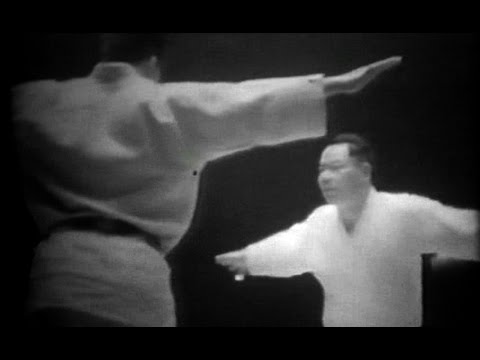
This excerpt comes from a demonstration held during the first edition of the European Judo Championship, which took place on December 5–6, 1951, at the Vélodrome d'Hiver in Paris before an audience of more than 10,000 spectators.
The demonstrators included Mikonosuke Kawaishi and Shozo Awazu, pioneers of French Jūdō; Minoru Mochizuki, founder of Yoseikan Budō; and André Nocquet, the first foreign uchi-deshi of Morihei Ueshiba.
It is likely one of the very first public demonstrations of Aikido in the West.
🔖 Technique Notes
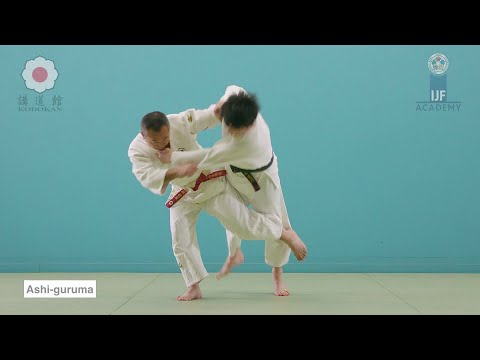
As Uke lifts a chair and strikes downward in a motion resembling Shōmen Uchi, Tori sidesteps to the outside to move off the line of attack. As he does so, he seizes both of Uke’s arms—gripping the sleeve of the inside arm and the shoulder of the nearer arm—in a modified Jūdō kumikata.
Driven by the inertia of his own strike, Uke is already heavily unbalanced forward. Tori’s off-line movement and grip further amplify this kuzushi, increasing the forward collapse.
As they rotate together, Tori partially turns his back to Uke and places his leg across Uke’s body, aiming to position it at thigh level in what appears to be an Ashi Guruma attempt. However, because Uke’s forward momentum is so strong—he is essentially already falling—Tori does not have time to fully extend and set his blocking leg. The incomplete barrier compromises Tori’s balance as well.
Both fall to the ground, but with different outcomes: Uke lands flat on his back, while Tori remains more upright, dropping onto his hips and immediately securing a dominant top position.
Advanced navigation tools (graph, timeline & deep research).