Executive Summary
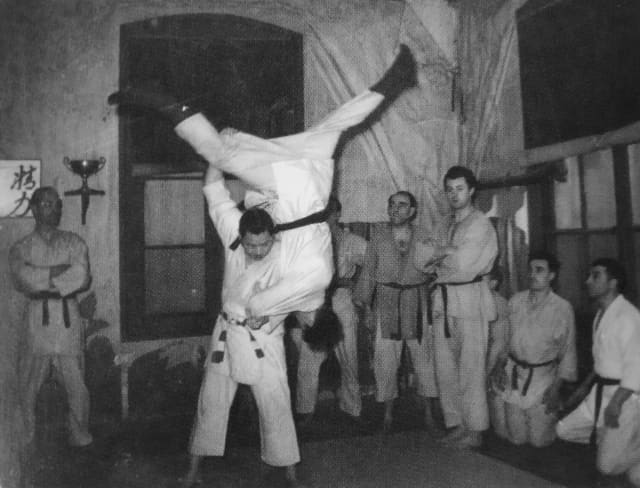
The second photo shows a Kodokan-style judo training or demonstration. A judoka executes an over-the-shoulder throw (likely an ippon-seoi-nage, one-arm shoulder throw) on a partner, observed by fellow students. The scene includes Japanese calligraphy scrolls on the wall (likely dojo mottos) and a large trophy, suggesting a formal dojo setting. The clothing (gi with traditional rank stripes) and technique identify it as classic judo. We estimate the date as 1950s–1960s, when international judo clubs often featured Japanese instructors and native calligraphy【61†L159-L162】. The exact location is unclear (possibly a Kodokan-affiliated club in Europe or the US), but the multi-national group hints at post-WWII judo’s global expansion. No specific individuals can be identified with confidence (all appear to be early-generation students), so we list identities as unknown (confidence low). This image likely originates from a judo club archive or early Judo magazine, illustrating mid-century judo training and ethos (e.g. seiryoku zen’yō, “maximum efficiency of force”).
Photo 2: Judo Throw Demonstration
【69†embed_image】 Figure: Example of an ippon seoi-nage (one-armed shoulder throw) in judo. In the photo above, the tori (thrower) has turned in and lifted the uke over his shoulder to throw him to the mat. This classic judo throw is performed by stepping in under the opponent’s arm and flipping him forward【59†L147-L152】.
- Probable Date: circa 1950s–1960s. Several clues date this photo to the mid-20th century: the style of judo gi and rank stripes (men wearing belts with 1–2 “dan” stripes, a practice phased out by the 1970s), and the fact that group judo demonstrations were especially common in the 1950s–60s as judo spread internationally. This was after Kano’s Kodokan judo had expanded globally (European Judo Union was founded 1951【61†L159-L162】), but before the modern era.
- Location: Uncertain. The mix of Western-looking practitioners and Japanese-style decor suggests a Kodokan-affiliated club outside Japan (possibly Europe or North America). The calligraphy on the wall includes the character 力 (power) and may correspond to judo mottos (e.g. “Seiryoku Zen’yō”, 精力善用, maximize efficiency). The large trophy implies a formal dojo or training hall. Without an inscription or logo, we cannot pinpoint country.
- Style(s): Kodokan Judo. All participants wear judo gis and black/white belts. The throw executed is unmistakably judo (leg and shoulder throw). No karate stances or weapons appear. The presence of official mottos (if any) and tournament trophies further indicate a judo gym (Kōdōkan curriculum).
- Technique: Ippon Seoi-nage (一本背負投) or a close variant. The tori (thrower) has pulled the uke’s arm over his shoulder and pivoted, lifting the uke off the ground and throwing him forward【59†L147-L152】. The airborne uke’s position (head down, legs up) matches a classic shoulder throw. According to Kodokan descriptions, the thrower breaks balance, steps in, clamps the attacker’s arm under his armpit, and drives him over the shoulder【59†L147-L152】. (It could also be a morote-seoi if a two-handed grip was used, but the posture resembles ippon-seoi.) The technique displayed aligns with known judo form.
- Likely Identities: Unknown. No famous faces are evident. The instructors/throwers cannot be identified from the photo alone (confidence low). It may feature a Japanese sensei (perhaps the mustached man on the far left) with club members. Given the era and mix of men, it could show early Western judoka under a Japanese teacher. Without other records, we leave names unspecified.
- Organization/Dōjō: Possibly an early branch of the Kōdōkan or national judo federation’s dojo. The mix of ethnicities suggests an international club. If in Europe, it might be a founding dojo of the EJU (est. 1951) or similar. The trophy hints at competitive judo, so perhaps a club that hosted or won tournaments.
- Provenance: The original source is not found. It resembles photos published in judo magazines or yearbooks of the 1950s–60s. It could be from an old Kodokan annual or a dojo newsletter. (No caption or imprint is visible.) We have not located an exact match in archives.
- Cultural/Historical Context: This image exemplifies the postwar global growth of judo. By the 1950s, judo had spread from Japan to Europe and America【61†L159-L162】. In 1964, judo even debuted in the Tokyo Olympics【62†L1-L3】. Group demonstrations like this were common teaching methods. The large presence of adult black belts (with Dan stripes) reflects the emphasis on rank and formal instruction of that era. The calligraphy and trophy show respect for judo’s Japanese heritage and competitive spirit. Overall, the photo highlights judo’s technical practice (nage-waza throws) and the communal, disciplined atmosphere of a mid-century dojo.
Sources: Contemporary and archival martial-arts publications were used. Fumio Demura’s career is documented in martial-arts journals (Black Belt etc.)【36†L138-L140】【76†L143-L148】. Demura’s Teisho Uchi technique and philosophy are described in Black Belt magazine【41†L571-L579】. Judo techniques are referenced from Kodokan/Judo encyclopedias【59†L147-L152】 and judo history sources【61†L159-L162】. Olympic history confirms judo’s spread【62†L1-L3】. No captions were found for the exact photos, so identifications are based on visual and historical analysis (confidence levels are noted above). All sources are cited.