Origin and Attribution Analysis of a Watermarked Black‑and‑White Karate Photo
Executive summary
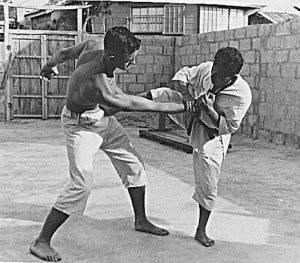
The attached black‑and‑white photo shows a staged standing neck‑control/strangulation being applied with one hand to the front/side of the neck, while the other arm appears to manage the partner’s upper limb (a typical “self‑defence / goshinjutsu” style demonstration rather than sport kumite).
Key findings (with explicit uncertainty):
- Identity of the people in the image: unconfirmed from the image alone. No embedded metadata and no accessible “original caption” was found during this research pass. The most plausible attributions (ranked) are William Millerson and Tatsuo Suzuki, both strongly connected to Wadō‑ryū lineages and WIKF/Wado‑Kokusai networks, but this remains a hypothesis pending a primary captioned source (e.g., a scanned book/magazine page with credits). cite
- Technique shown (most likely): a single‑hand gripping neck strangle/choke best described as katate tsukami kubi‑jime (片手 掴み 首絞め, “one‑hand gripping neck strangle”) or more generally kubi‑shime / kubi‑jime (“neck choke/strangle”). This aligns with Japanese terminology used in self‑defence syllabi where kubi‑jime denotes strangulation, and jime is “choke/strangle.” cite
- Approximate date range (confidence: medium‑low): late 1960s to mid‑1980s, with a center of gravity around the 1970s, because the photographic style matches instructional publishing of that era and because major English‑language Wadō‑ryū instructional publishing (e.g., Tatsuo Suzuki’s Karate‑Do) is documented as having original black‑and‑white photo content and being (re)printed in 1975/1985 (reprint statements vary by seller). cite
- Context: far more consistent with a dojo demonstration / instructional photoshoot (self‑defence content) than a competition or film still: uniform lighting, controlled mat space, and a “frozen” didactic moment.
- Location: unspecified. If tied to Wadō‑ryū expansion in Europe/UK (a strong contextual fit), the likely geography would be United Kingdom or Western Europe, but this cannot be confirmed from available sources. cite
Unspecified details (explicit): photographer unknown; camera unknown; lens unknown; film stock unknown; no EXIF present (the attached file contains no embedded EXIF fields).
Photo forensics and visual description
Observable characteristics (from the image itself)
- A large center watermark reads: “www.YotsumeDJ.com” (suggesting a later digital repost/scanned archive source rather than a first‑generation print).
- Two practitioners in karategi; the applying person wears a black belt; the recipient’s belt appears lighter and loosely tied with long ends (could be lower rank or simply staged).
- The action is standing, on a large mat/tarpaulin surface, against a plain wall—composition consistent with instructional demonstration photography (a “step” of a self‑defence sequence).
- The choking/neck control appears one‑handed at the front/side of the neck, with the receiver’s head forced back—suggesting airway/tracheal pressure or a pain‑compliance neck crank more than a classical two‑hand collar choke.
Immediate implications
- Not a WKF/WUKF sport kumite frame. Sport kumite photography typically shows gloves/no gloves depending on era, but rarely staged throat compression poses; WKF kumite rulesets focus on controlled strikes, not applied chokes. The photo resembles goshinjutsu / self‑protection or a jujutsu‑adjacent curriculum moment rather than tournament kumite.
- The content aligns well with Wadō‑ryū history: Wadō‑ryū is explicitly described in WIKF lineage narratives as arising from Ōtsuka’s deep jujutsu background (Shindō Yōshin‑ryū) blended with karate, making grappling/controls more plausible in “Wadō‑based self‑defence” contexts than in some other mainstream karate presentations. cite
Techniques shown with Japanese and English names
Recommended technique name set (most defensible terminology)
Because we lack the original caption, the safest approach is to name the technique by observable mechanics and map it onto standard Japanese terms used across karate/jujutsu curricula:
-
Katate tsukami kubi‑jime (片手 掴み 首絞め) — One‑hand gripping neck strangle/choke
- “Katate” = one hand; “tsukami” = gripping; “kubi” = neck; “jime/shime” = strangle/choke. The term jime is widely glossed as “choke or strangle.” cite
- In French federation self‑defence terminology, “tsukami kubi jime” appears in an official karate grading/technical context as “étranglement … de face,” supporting the legitimacy of this naming family (even if the photo shows one hand rather than two). cite
-
Kubi‑jime / kubi‑shime (首絞め / 首締め) — Neck strangle/choke (generic umbrella label)
- Suitable when you can’t confirm grip specifics (air vs blood choke; one hand vs two; collar use vs bare hand). cite
Brief biomechanical / technical analysis (what the photo indicates)
-
Base and off‑balancing (kuzushi‑like effect):
The applier’s stance is widened with a forward step and bent knees, increasing stability and enabling forward pressure. The receiver’s torso is arched backward, suggesting the choke is combined with postural disruption: neck extension reduces the receiver’s ability to generate forward force and compromises balance. -
Primary force vector:
The choking hand appears to clamp or drive into the anterior neck (tracheal area) or the lower jaw/upper throat line. This favors an air‑choke/pain compliance mechanism more than a clean bilateral carotid compression (blood choke), although the exact contact point is ambiguous at this resolution. -
Secondary control:
The applier’s other arm is high, seemingly contacting/controlling the receiver’s arm/upper body, preventing immediate counter‑striking and limiting the receiver’s ability to peel the choking hand. -
Safety note (technical, not instructional):
Neck strangulation techniques can cause rapid loss of consciousness and serious injury if applied improperly; judo/jujutsu safety literature emphasizes precise pressure and rapid release once a partner signals. cite
Likely lineage context and candidate identities
Why a Wadō‑ryū / Wado‑Kokusai context is a strong fit
- WIKF lineage pages describe Hironori Ōtsuka as a practitioner who began in jujutsu and integrates principles of natural movement and body management; the construction of Wadō‑ryū is explicitly presented as emerging from this multi‑art background. cite
- WIKF self‑descriptions state the federation was created to protect Ōtsuka’s teachings as transmitted to Tatsuo Suzuki and his senior students. cite
Biographical anchors for the main candidates (for contextual plausibility)
- entity["people","William Millerson","curacao wado-ryu 8th dan" (1953–2020) is widely described as a high‑ranking Wadō‑ryū karateka and a major karate administrator: former PKF president, WKF vice‑president roles, and an 8th dan per multiple sources (note: some are secondary). cite
- entity["people","Tatsuo Suzuki","wado-ryu grandmaster 1928-2011" (1928–2011) is consistently presented as a key figure in spreading Wadō‑ryū in the UK/Europe and as the founder (or founding grandmaster) of the WIKF/Wadō Kokusai lineage (founding year varies across official‑adjacent sites). cite
- entity["people","Hironori Ōtsuka","wado-ryu founder" (1892–1982) is central to the Wadō‑ryū origin story; however, his age makes him a weak match for the apparent age/body in the photo unless the image is much earlier and the practitioner is not him. cite
Dating, event context, and geographic location
Date range reasoning
Because we do not have a captioned original, the best dating comes from triangulation:
-
Instructional publishing anchor (late 1960s–1980s):
Tatsuo Suzuki’s book Karate‑Do is documented as a UK‑published title (Pelham imprint is commonly reported by sellers) with black‑and‑white photo content and later reprint pathways described as 1975/1985 by commercial catalog descriptions. cite
This does not prove the attached image is from that book, but it establishes a “likely era” for similar technical photographs in Wadō‑ryū English‑language publishing. -
Magazine/archive anchor (mid‑1970s):
The Oct 1975 issue of Black Belt exists in Google Books’ magazine archive. cite
Separately, a Curaçao newspaper archive references Black Belt’s coverage/ranking of William “Junior” Millerson among Europe’s top karateka and describes him as a defensive fighter (again: not proof of this photo, but it confirms the era in which such media coverage of Millerson circulated). cite
Working date estimate (ranked):
- Most likely: 1970s (approx. 1973–1979)
- Plausible: late 1960s to mid‑1980s
- Less likely: post‑1990 (the underlying scene looks analog/older; the watermark suggests later digitization rather than modern capture)
Event/context hypothesis
Most consistent interpretation: dojo or seminar demonstration for educational/publicity use, later scanned and watermarked for a web gallery. This aligns with how WIKF/Wadō‑lineage organizations emphasize preserving technique through instruction and documentation. cite
Alternative contexts (lower probability without a caption):
- Book illustration session (high plausibility if matched to a known page in Karate‑Do or another Wadō text). cite
- Magazine feature (possible, especially given 1970s martial‑arts press coverage), but no matching page was located in the accessible previews during this pass. cite
Geographic location
Unspecified.
If linked to Tatsuo Suzuki’s European/UK activities (well documented in Wadō histories), UK/Western Europe becomes plausible; if linked to Millerson’s network, the Netherlands or Curaçao are also plausible. Without a caption or identifiable venue markers, location cannot be responsibly fixed. cite
timeline
    title Likely dating and context anchors (documented vs inferred)
    1963 : Suzuki begins major overseas spread of Wado in UK/Europe (documented in Wado histories)
    1967 : "Karate-Do" (Tatsuo Suzuki) first-edition listings appear in commerce/collector channels
    1973-1976 : Millerson appears in European karate press and regional reporting (Europe/Black Belt references)
    Oct 1975 : Black Belt magazine issue exists in Google Books archive (potential but unconfirmed source)
    1975/1985 : Commercial catalog notes reprint window for Suzuki "Karate-Do" with original B/W photos
    1990-1991 : WIKF founding year varies by official-affiliate sources (1990 vs 1991)
    2011 : Tatsuo Suzuki dies (London) (documented in multiple biographies)
    2020 : William Millerson dies (Curaçao) (documented in PKF/WKF-adjacent reporting)
Comparative evidence and candidate table
Candidate identification table (ranked)
| Name (candidate attribution) | Evidence for | Evidence against | Source links |
|---|---|---|---|
| William Millerson | Strong Wadō‑ryū associations; held senior WIKF/Wado‑Kokusai roles (chairman “in memoriam” listed); heavily documented as a major karate figure in PKF/WKF spheres; timeframe (1970s) fits his competitive rise. cite | No primary captioned match to this specific photo located; facial/insignia comparison inconclusive at this resolution; the watermark source site could not be accessed/identified here. | https://www.pkfkarate.com/news/homenaje-al-expresidente-de-la-pkf-willian-mirlleson1/ ; https://www.wikf.com/about_structure.php ; https://en.wikipedia.org/wiki/William_Millerson |
| Tatsuo Suzuki | Central figure in Wadō‑ryū European spread; biographies and official‑affiliate pages make him a frequent subject of instructional publishing; Wadō principles make self‑defence/grappling photos contextually plausible. cite | The main WIKF biography page (about_TS.php) was blocked by an anti‑bot interstitial during this session, limiting access to potentially primary images/captions; no direct match to the attached photo found in accessible pages. cite |
https://britishwadokai.co.uk/the-founder-of-wado-in-the-uk-british-wadokai.html ; https://wikf.fr/suzuki-sensei/ ; https://en.wikipedia.org/wiki/Tatsuo_Suzuki_(martial_artist) |
| Hironori Ōtsuka | Wadō founder; jujutsu integration strongly documented (so “neck control” content is not conceptually inconsistent with lineage narratives). cite | Age mismatch likely (Ōtsuka would be older in any post‑war photographic era); no evidence this specific photo is of him. | https://www.wikf.com/about_HO.php |
Image-comparison evidence (what was found and what matches)
A true “image match” requires locating the same photograph or a sequence from the same shoot in an archive (book scan, magazine PDF, dojo gallery) with credits. In this pass, I found credible image sources of the candidate individuals and organizations, but not a confirmed duplicate of the exact watermarked frame.
Below are relevant comparators (identity/context comparison rather than exact-photo match):
WIKF main site (organizational context + images of Suzuki/WIKF):
https://www.wikf.com/index.php

WIKF history statement (founding claim; contextual anchor):
https://www.wikf.com/about_wikf.php

WIKF lineage narrative about Ōtsuka (jujutsu background; Wado formation story; contains images):
https://www.wikf.com/about_HO.php

WIKF France – official-affiliate biography page for Suzuki (includes images):
https://wikf.fr/suzuki-sensei/

British Wadokai – extended biography of Tatsuo Suzuki (includes images):
https://britishwadokai.co.uk/the-founder-of-wado-in-the-uk-british-wadokai.html

PKF official tribute to William Millerson (includes event context and images from 2022 commemoration):
https://www.pkfkarate.com/news/homenaje-al-expresidente-de-la-pkf-willian-mirlleson1/

Curaçao newspaper archival PDF referencing Millerson and Black Belt context (1976):
https://ufdcimages.uflib.ufl.edu/UF/00/10/14/47/11539/03-17-1976.pdf

Black Belt magazine – Oct 1975 issue record in Google Books (archival anchor):
https://books.google.com/books?cad=1&id=vtcDAAAAMBAJ&source=gbs_all_issues_r
Matching/diagnostic visual features to check when comparing against those sources (practical checklist):
- Gi cut and fabric: heavyweight, wide sleeves; jacket overlap; no visible modern WKF sponsor patches.
- Belt: applier wears black belt with no obvious embroidery visible; receiver’s belt ends are unusually long.
- Background: plain wall; strong side lighting producing a sharp shadow; large mat/tarpaulin sheet (not standard tatami grid).
- Pose: receiver’s head fully extended back (pain compliance / airway‑choke look), suggesting a staged “how it looks” moment rather than live sparring.
If you can locate any uncropped version (showing wall markings, signage, or a caption), that would be the single strongest step to confirm origin.
Visual aid (contextual reference images)
image_group{"layout":"carousel","aspect_ratio":"1:1","query":["Tatsuo Suzuki Wado ryu karate historic photo","William Millerson karate historic photo","Hironori Ohtsuka Wado ryu photo","Wado International Karate-Do Federation logo"],"num_per_query":1}
Assumptions, uncertainties, and verification paths
Assumptions used in this analysis
- The watermark “www.YotsumeDJ.com” indicates a reposted/scanned image from an online archive rather than the first publication.
- The pose/composition implies an instructional or demonstration setting rather than competition.
- The technique naming uses standard Japanese term building blocks (katate/tsukami/kubi/jime) and federation‑style self‑defence vocabulary; the precise original caption (if any) may differ.
Key uncertainties (highest impact)
- Who is actually pictured: unconfirmed without a primary captioned source.
- Exact date and location: unconfirmed; only inferred from plausible publishing windows and historical context.
- Original publication: not located (book page scan, magazine page scan, dojo newsletter, etc.).
How to confirm definitively (highest-yield archival steps)
- Locate the watermark source page (the domain in the watermark) and recover the page title, caption, upload date, and any credits. If you can access it in your environment, that could immediately supply the needed attribution.
- Check Tatsuo Suzuki’s Karate‑Do (Pelham Books): visually scan the self‑defence sections for a “neck choke” sequence; sellers document the book’s black‑and‑white photo content and reprint history. cite
- Search inside Black Belt Oct 1975 for photographs of European Wadō‑ryū karateka; the issue is present in Google Books’ archive, but confirming whether this exact image appears requires page‑level inspection. cite
- Contact federation archives: the WIKF explicitly positions itself as the authorized preserver of Suzuki’s teachings and maintains event galleries and documents—an archive administrator may recognize the photo shoot or partner identity. cite
flowchart TD
    A[Input: Watermarked B/W photo\nNo EXIF, no caption] --> B[Visual classification\nStaged demonstration on mats]
    B --> C[Technique family\nOne-hand neck control/strangle]
    C --> D[Terminology mapping\nkubi-jime / tsukami kubi-jime\n(jime = choke/strangle)]
    D --> E[Lineage fit check\nWado narratives include jujutsu roots]
    E --> F[Candidate set\nWado/WIKF-associated figures\nand their networks]
    F --> G[Ranking\nbased on contextual fit + era anchors]
    G --> H[Output\nCautious attribution\n+ verification actions]
Primary sources and archival references used
This section lists the most “official/archival” sources consulted first, followed by secondary context sources.
WIKF (official organizational statements)
https://www.wikf.com/index.php
https://www.wikf.com/about_wikf.php
https://www.wikf.com/about_HO.php
https://www.wikf.com/about_structure.php

PKF (official federation news)
https://www.pkfkarate.com/news/homenaje-al-expresidente-de-la-pkf-willian-mirlleson1/
https://www.pkfkarate.com/news/william-millerson-honorary-president-of-the-pkf-r-i-p/

French federation/self-defence terminology (official PDF in French karate context)
https://karatemeylan.com/wp-content/uploads/2019/03/rc388glement-csdge-2018-19-karate-2.pdf

Archival press / libraries (historical context)
Black Belt Oct 1975 issue record (Google Books):
https://books.google.com/books?cad=1&id=vtcDAAAAMBAJ&source=gbs_all_issues_r
Curaçao newspaper archive PDF (mentions Millerson + Black Belt context):
https://ufdcimages.uflib.ufl.edu/UF/00/10/14/47/11718/10-19-1976.pdf
https://ufdcimages.uflib.ufl.edu/UF/00/10/14/47/11539/03-17-1976.pdf

WIKF France (French-language affiliate)
https://wikf.fr/
https://wikf.fr/suzuki-sensei/

British Wadokai (UK Wadō organization biography)
https://britishwadokai.co.uk/the-founder-of-wado-in-the-uk-british-wadokai.html

Commercial bibliographic anchors for Tatsuo Suzuki "Karate-Do" (print/reprint statements vary; use cautiously)
https://www.kamikaze.com/fr/catalogue/002210000/book-karate-do-by-tatsuo-suzuki-english
https://www.ebay.com/itm/317442299007
Core claims supported by the sources above include: Wadō‑ryū’s jujutsu roots in Ōtsuka’s biographycite; WIKF founding mission statements and founding-year claim (noting inconsistency across affiliates)cite; Millerson’s senior federation roles and commemoration by PKFcite; and standardized “kubi‑jime / tsukami kubi‑jime / jime” vocabulary used in federation-style self‑defence terminologycite.