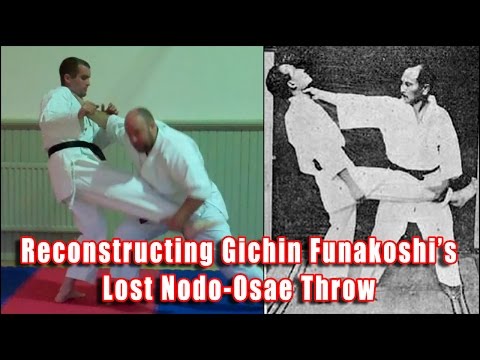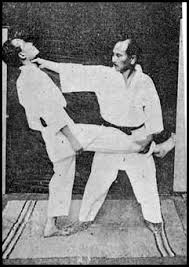
Nodo Osae – Gichin Funakoshi Rentan Goshin Tōde Jutsu Variation (1925)
⛩️ Source
This image comes from Rentan Goshin Tōde Jutsu, page 58, figure 62, published in Japan in 1925. The book was written by Gichin Funakoshi, one of the pioneers responsible for introducing Okinawan karate to mainland Japan. The title Rentan Goshin Tōde Jutsu (錬膽護身唐手術) may be translated approximately as “Forging the Spirit Through the Art of Karate Self-Defense,” using the older Okinawan-era term Tōde (“Chinese Hand”) for Karate. The work is among the earliest published Japanese karate manuals and documents several self-defense techniques, throws, joint controls, and kata applications from prewar Okinawan karate traditions. This technique, identified as Nodo Osae (“Throat Press” or “Throat Restraint”), is one of the six throws presented in the book.
🔖 Technique Notes
The litteral traduction of the description of this image is : “Receiving the opponent’s incoming right hand with your right hand in a reverse manner, immediately change the reception to the left hand, shift that hand and grasp the neck, being on the verge of toppling the opponent.”
However, this description does not explain how Tori comes to control Uke’s ankle. We can assume that, following the initial entry and hand exchange, Tori applies pressure to Uke’s neck or throat, forcing Uke’s weight backward onto the rear leg. As Uke’s balance shifts rearward, the lead leg becomes temporarily unweighted and easier to seize. Tori then lowers the rear hand to grasp the ankle from above while maintaining the throat pressure with the lead hand, and simultaneously traps Uke’s rear foot by stepping onto it with the lead foot.
By controlling both of Uke’s legs — one lifted at the ankle and the other immobilized underfoot — Tori is able to break Uke’s balance completely and finish the takedown through the pressure applied to the throat.
Advanced navigation tools (graph & deep research).