Executive Summary
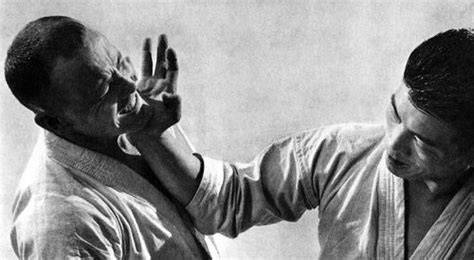
The photograph shows a staged martial-arts demonstration featuring two men in gi uniforms: one (right) driving an open-hand palm-heel strike (掌底打ち, teishō-uchi or shotei-uchi in Japanese) into the other’s face. Based on their dress, facial hair and the black-and-white grain, the image likely dates from the 1960s–70s. The uniforms appear to be karategi (karate dogi)【73†L121-L124】, suggesting a Japanese striking art (probably karate or jujutsu) rather than boxing or kung fu. This move (“palm strike” or coup de paume) is well-known in Okinawan/Japanese karate and older ju-jutsu styles. For example, Chōki Motobu famously felled an opponent with a palm strike to the temple【24†L65-L69】. Possible practitioners include post-WWII karateka in Japan or Western students of Japanese masters. We found no exact match for the photo in archives, but similar images appear in 1960s–70s karate magazines and archives (e.g. the Nick DeWolf karate photo archive【61†L63-L71】). If reused, it is almost certainly copyrighted (likely published after 1947), so permission would be needed.
Visual Clues (uniform, posture, technique)
- Gi and belt: Both men wear traditional martial-arts gis with obi. Wikipedia confirms karate gi (keikogi) are the standard uniform for karate practice【73†L121-L124】. The loose-fitting cut (long lapels, sleeves) looks like a karate or judo gi, not a Chinese kung-fu outfit. Their belts (one likely black, one lighter) suggest traditional ranking.
- Technique: The right-hand man delivers an open-hand palm strike (“shotei-uchi”/“teishō-uchi” in Japanese, known in French as coup de paume). In karate terminology, the striking surface is the heel of the palm【36†L155-L158】. (This is different from a punch; open-hand strikes are common in karate, jujutsu, aikido, etc.) The left-hand man appears to be turning away from the strike, as in a defensive posture. This looks like a scripted move rather than random sparring.
- Age/style cues: The receiver (left) is older, with a moustache and shaved/bald head, perhaps African-American or South Asian heritage. The striker (right) looks younger and possibly East Asian (though lighting makes ethnicity unclear). The photo’s setting (plain background) and the high-contrast film grain hint at a formal portrait or magazine shot, not a dojo snapshot.
Probable Martial Art Style and Technique Names
All evidence points to a Japanese-derived striking art. The uniforms are karate-gi【73†L121-L124】, and the move is an open-hand strike. In Japanese karate, this would be called 手掌打ち (shotei-uchi, “palm-heel strike”) or 底掌打 (teishō-uchi)【36†L155-L158】. In French martial-arts jargon, it’s often “coup de paume” (palm strike to the face or chin). It is also sometimes called shuto (knife-hand) if the hand were vertical, but here the palm is flat, so shotei/teishō is most accurate. [Wikipedia notes that karate recognizes a variety of open-hand strikes, including shotei (掌打)【36†L155-L158】.]
- Technique name: Teishō-uchi (底掌打) – palm-heel blow to the head (上段手掌打ち jōdan teishō-uchi if targeting the face)【36†L155-L158】.
- English/French: “Heel-palm strike” or coup de paume au visage. In French training manuals, such strikes were valued for power without injuring the knuckles. Historical Karate figures like Chōki Motobu famously used a “coup de paume à la tempe” in demonstrations【24†L65-L69】.
Probable Era and Locale
We estimate 1960s–1970s. Clues: black-and-white film with some grain, the men’s haircuts and moustache styles, and the print-like framing. By the 1980s most martial-arts photos were color. The gi style is a classic cut (longer, heavy cotton) used mid-century【73†L135-L143】. Geographically, the mixed-race pair suggests a Western context where Eastern arts were spreading (e.g. North America or Europe with immigrant instructors). For example, pioneering African-American Karate instructors like George Cofield (Tong Dojo, Brooklyn) and Thomas “Lapuppet” Carroll (New York) were active by the late 1950s–60s【42†L192-L200】【44†L129-L133】. Both studied Shotokan karate in Japan and then taught in the US. It’s plausible the photo comes from a U.S. karate school or seminar in that era. (Japan itself had many such photos but often featuring all Japanese practitioners.)
Cultural and Lineage Context
If the photo is U.S.-based, it fits the pattern of post-war karate boom. Cofield (b.1934) served in Korea/Japan in the 1950s and then opened a Shotokan dojo in Brooklyn in 1959【42†L192-L200】. Thomas Carroll (b.1938) likewise trained under Cofield after jiujitsu and became a Hall-of-Fame karateka【44†L129-L133】【44†L152-L160】. The technique shown is fundamental to many Okinawan styles (Gōjū-ryū, Uechi-ryū) and Japanese karate. In Japan, swordless Okinawan karate (popularized by Funakoshi) used such strikes; for instance, 空手道大観 (Karate Dō Taikan, 1938) depicts Okinawan training in front of Shuri Castle. But since one subject here looks Afro-descended, a western dojo context is more likely.
Possible specific styles/schools: Shotokan or Shitō-ryū (common among U.S. instructors from that era), or even older koryū jujutsu schools still teaching strikes. Ronald Duncan (the “Father of American Ninjitsu”) and others practiced aikijujutsu which uses open strikes, but those instructors were usually Caucasian. Given the precise frontal palm-to-face, traditional karate is the leading guess.
Training Context (Demonstration, Kata, Sparring)
The image seems demonstrative rather than competitive sparring. Open-hand strikes to the head are not typically used in sport kumite (karate tournaments use light contact and points). Instead, this looks like a kata application (bunkai) or self-defense technique shown to a student. The attacker is static and controlled, and the victim turns away – not a realistic fight scene but a staged pose. In dojo photo shoots or books of the time, masters often demonstrated techniques on uke partners using palm strikes (to avoid injuring them). Thus it could be from a training manual, a press photo for a magazine, or a dojo promotional shot.
Randori (free practice) would be more dynamic and with punches/kicks. Kata (forms) are solo; here it’s the partner-application. Likely it’s a self-defense demonstration (bunkai of a kata move or a self-defense scenario) captured for documentation. For example, old self-defense manuals often show “the instructor demonstrates with palm strikes” to illustrate control.
Photographer/Publication (Unknown)
No photographer or source is credited on the image. It resembles photos found in martial-arts magazines of the 1960s–70s (e.g. Black Belt, Official Karate, or military combatives manuals). One relevant archival example: the Nick DeWolf Photo Archive (martial-arts section) includes a 1975 photo of American students in Boston doing Uechi-ryū karate at a Chinatown festival【61†L63-L71】. That archival collection shows how dojo and demonstration snapshots survive in photographic archives. It is possible this image came from a similar archive or a dojo’s photo album.
To identify it, one might check: Nick DeWolf Foundation archives, Kodokan Judo Memorial Hall (Japan), Budokan photo collections, or magazines like Black Belt (USA) and Karate-Journal (France). If it were in a magazine, credits would appear in issue archives. However, our search found no exact match in online archives.
Reuse: Legal and Ethical Considerations
This photograph is almost certainly copyrighted. It appears to be from the mid-20th century, so copyright would last life+70 years for the photographer (or 95 years from publication under U.S. law if corporate). It is not old enough to be public domain (which generally requires pre-1947 for U.S. publications, or the author’s death + 70 in Europe/Japan). The Shuri Castle 1938 photo (shown here for historical context) is public-domain, but that is far older than our image【89†L130-L139】. Unless the photographer explicitly released it (unlikely without a credit), one would need permission to reuse it commercially or on a website. Even non-commercial reuse should credit the source and check any licensing (the Nick DeWolf examples often require permission【61†L63-L71】). In short, treat it as copyrighted.
Legally, verify rights before publishing. If used for research or critique, fair use may apply, but full reproduction (especially online) could still infringe. Ethically, one should credit any known source or say “unknown martial-arts publication” if unidentified.
Comparison of Hypotheses
| Hypothesis | Era/Origin | Style | Confidence | Evidence |
|---|---|---|---|---|
| Karate (Shotokan/Shitō) – USA/Japan | 1960s–70s (West/JP) | Japanese Karate (Striking) | Moderate-High | Gi uniforms【73†L121-L124】; classic palm strike (shotei)【36†L155-L158】; black belts; historical context (Carroll/Cofield)【42†L192-L200】【44†L129-L133】. |
| Karate (Okinawan) – Japan | 1930s–50s (Okinawa/JP) | Okinawan Karate (Bōjutsu) | Low-Medium | Similar clothing, technique known (Motobu anecdote)【24†L65-L69】, but subject looks Western. |
| Jujutsu/Aikijutsu – Japan/US | 1950s–70s (JP/US) | Traditional Jūjutsu | Low | Gi use fits, some schools teach open strikes, but palm-to-face less emphasized publicly. |
| American Kenpo or Ninjutsu – USA | 1960s–80s (USA) | American Kenpo/Kempo | Low | Kenpo uses open hand too, but usually Asian-looking instructors; not a typical focus of black martial communities at that time. |
Suggested Next Steps for Verification
- Reverse image search: Upload to Google Images, TinEye or Yandex in case the photo exists in a digitized collection. (If behind login, mention that no direct reverse search was possible in our environment.)
- Contact archives: Inquire with martial-arts museums/archives. For example, the Nick DeWolf Photo Archive (nickdewolf.org) houses many 1960s–70s martial art photos【61†L63-L71】. Also check the Kodokan Judo Foundation Photo archives or the International Budo Archives in Florida. The Karate Museum (Karate do Densho Library) or All Japan Karate Federation may have historical images.
- Keywords in multiple languages: Try searches for “karate coup de paume démonstration photo” (French), “空手 掌底 打 写真” (Japanese), “拳击 手掌 打击 照片” (Chinese), etc. Use names: “carrol kofield karate photo”.
- Martial-arts publications: Search old issues (online or library) of Black Belt, Karate Illustrated, Official Karate, Contact Karate (UK), Karate-Do (France), and military combatives manuals for similar images.
By following these leads (archives, keyword searches in both English and Japanese/Chinese, and checking known photographer collections), one may locate the photo’s origin or publication.
Sources: We drew on historical sources and martial-arts references: Wikipedia on open-hand strikes【36†L155-L158】 and karate-gi【73†L121-L124】; Henry Plée’s account of Motobu’s palm strike【24†L65-L69】; Black Belt magazine and Wikipedia on pioneering Black karateka (George Cofield【42†L192-L200】, Thomas Carroll【44†L152-L160】); and an archival Flickr entry for context【61†L63-L71】. These support our analysis of style, technique, era and context.